Timeframe: 2016–2024 (8 years)
Context
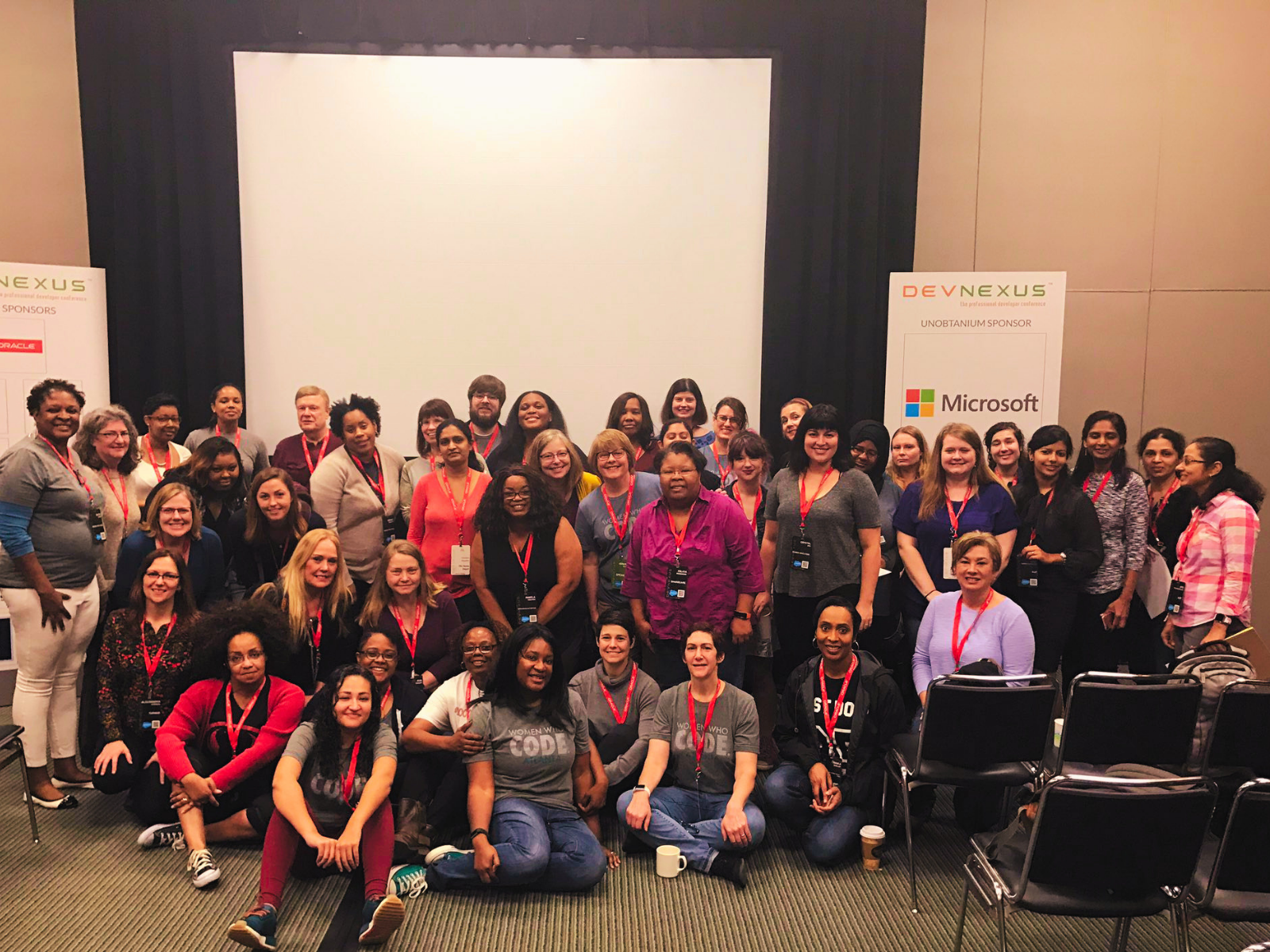
When I joined Women Who Code Atlanta as a Lead in 2016, and stepped into the Director role later that year, the local landscape for women in tech careers was fragmented. National conversations about diversity in tech were getting louder, but the day-to-day infrastructure that actually helps women grow in their careers, including recurring technical learning, peer community, mentorship, and exposure to hiring companies, was inconsistent across cities and chapters.
Atlanta was a rising tech hub with Fortune 500 companies, a growing startup ecosystem, two of the largest HBCUs in the country, and an expanding engineering workforce that lacked a centralized, high-quality technical community. WWC Atlanta was small but had real potential. The challenge wasn't starting from zero. It was transforming a passionate but lightly resourced chapter into a sustained, recognizable technical community.
Starting state
- Small, early-stage chapter with engaged founding members but limited recurring programming.
- No standing partnership pipeline. Each event required new sponsor and venue outreach.
- Atlanta's tech community was geographically dispersed, making consistent in-person attendance difficult.
- No dedicated budget. Programs relied on sponsorships, partnerships, and in-kind donations.
- Entirely volunteer-run, including the Director role.
Goals & success metrics
Over the eight-year period, the goals were to:
- Scale membership and make WWC Atlanta the default community for women technologists in the metro.
- Deliver consistent, high-quality technical programming across cloud, AI, product, and modern engineering practices.
- Build a sustainable operating model with partnerships, organizers, and recurring program cadences that could continue beyond any single leader.
- Earn recognition inside the global Women Who Code network as a model for active chapter leadership.
Metrics tracked over time included membership growth, monthly event count, active organizers, partner roster, attendance, study group completion rates, and chapter ranking within the WWC network.
Scope & constraints
Scope: Volunteer management, programming, partnerships, organizer recruitment, brand stewardship, and alignment with the global WWC organization. For the WeRISE Tech conference I owned ticket sales and promotion, social media, the promotional graphics and speaker cards, the 2018 themed identity across merch and print, and budget tracking across sales, sponsor revenue and expenses. Sponsor recruitment was shared across the director team.
Constraints:
- No paid staff.
- No fixed budget.
- Every recurring program needed a volunteer owner who could maintain cadence without burnout.
- Community consistency mattered more than isolated flagship events.
From 2020 onward, the chapter also had to fully pivot to virtual programming before later deciding what should remain virtual versus return in person.
Approach
I approached WWC Atlanta as a community operating system rather than simply a calendar of events. Key components included:
- Recurring program cadence: monthly meetups, study groups, hackathons, and workshops, each with a dedicated volunteer owner and repeatable runbook.
- Partner curation focused on long-term relationships with sponsors, venues, and companies invested in sustained community engagement.
- Organizer onboarding with clear pathways into leadership and ownership.
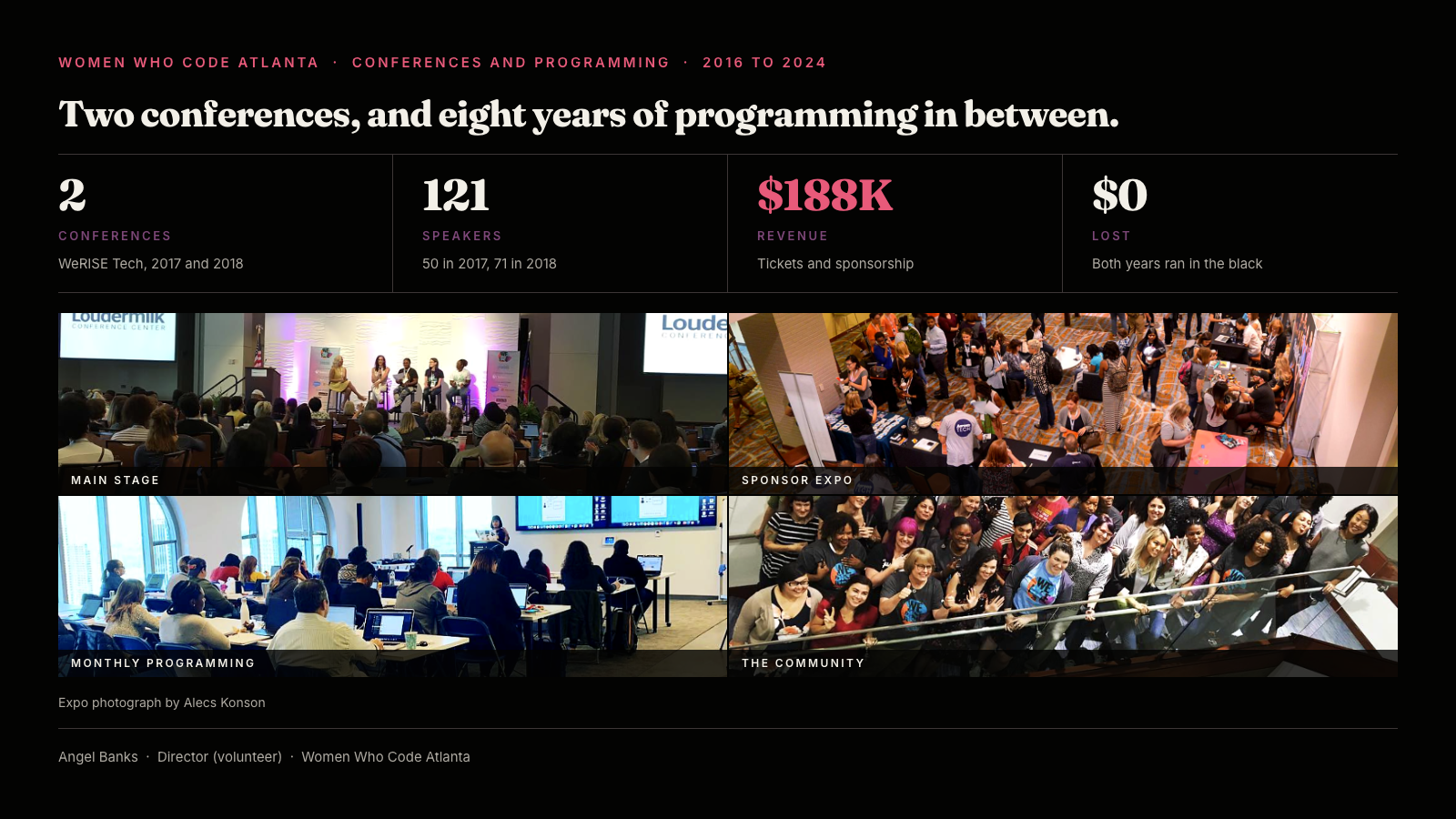
- Flagship moments like WeRISE Tech (2017 and 2018), multi-day inclusive developer education events with 50 speakers in 2017 and 71 in 2018. I ran ticket sales and promotion for both years, designed the promotional system, and tracked the full budget.
- A pandemic-era pivot to fully virtual programming in 2020–2021, followed by a deliberate hybrid strategy using virtual events for reach and in-person events for deeper engagement.
Across eight years, the chapter delivered 275+ developer education programs spanning cloud, AI, product, and modern engineering.
WeRISE Tech 2018: where the themed-edition model started
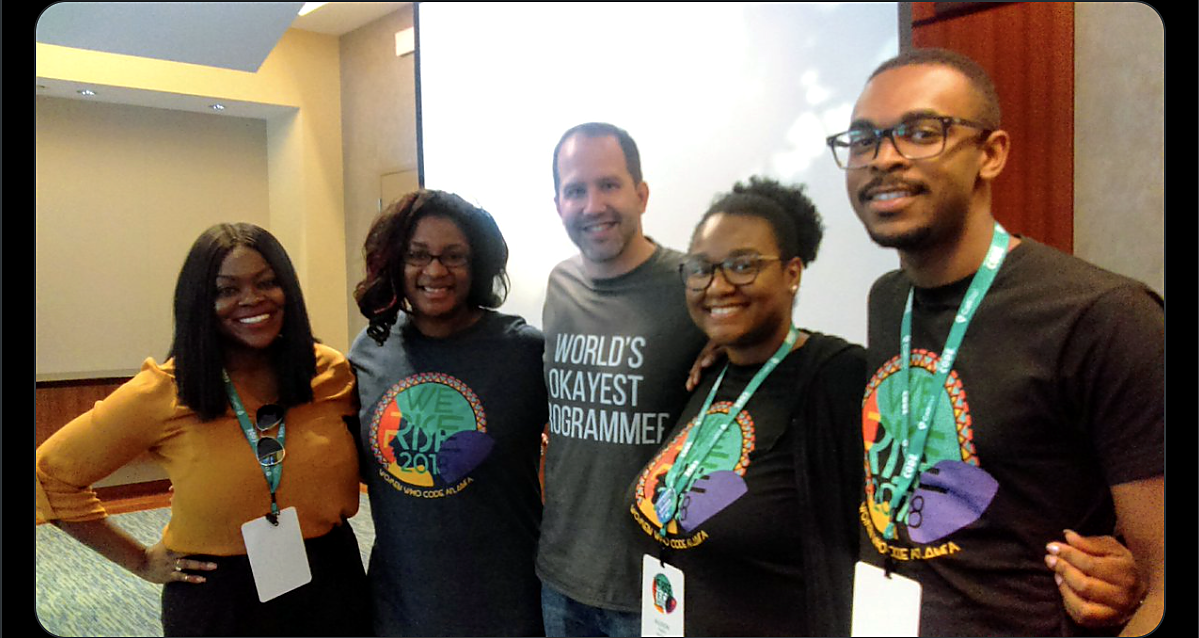
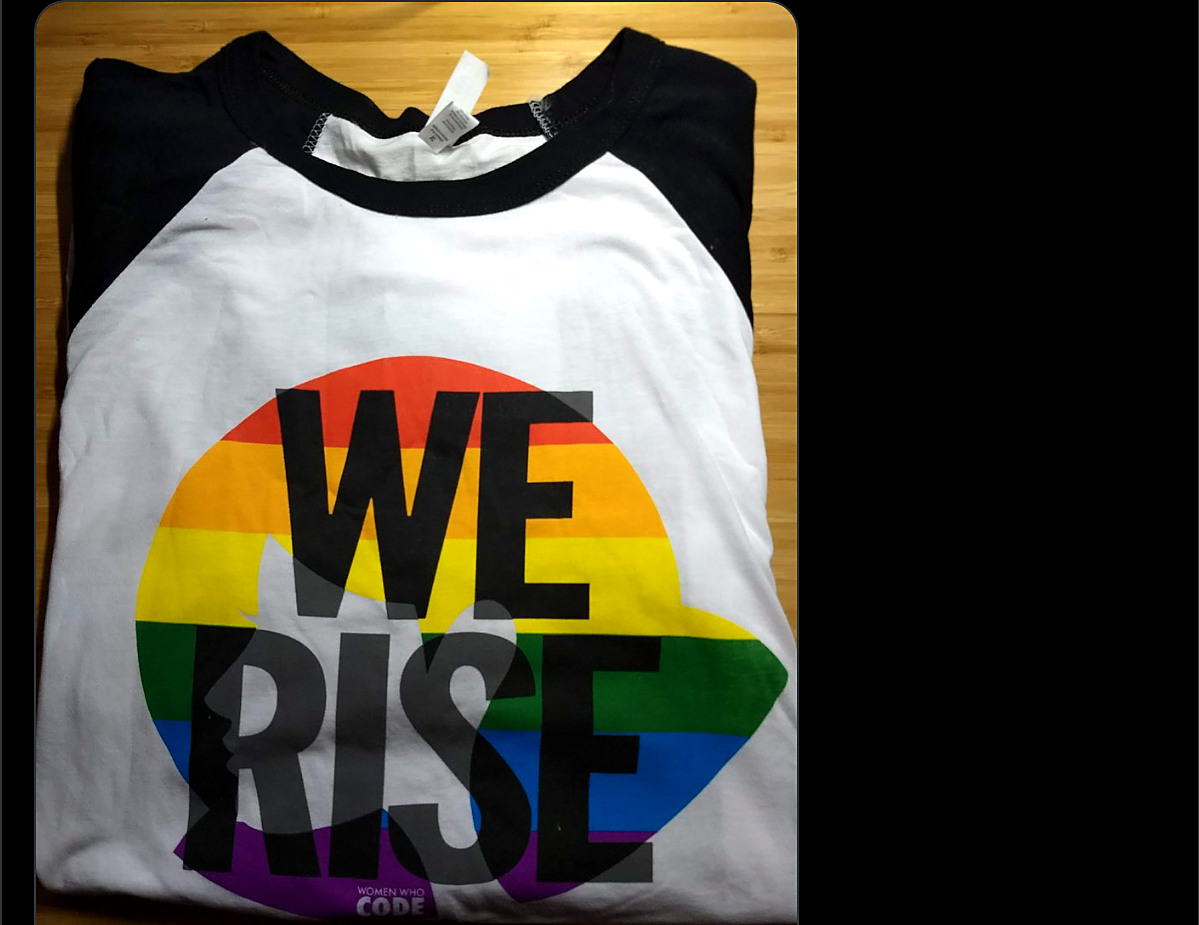
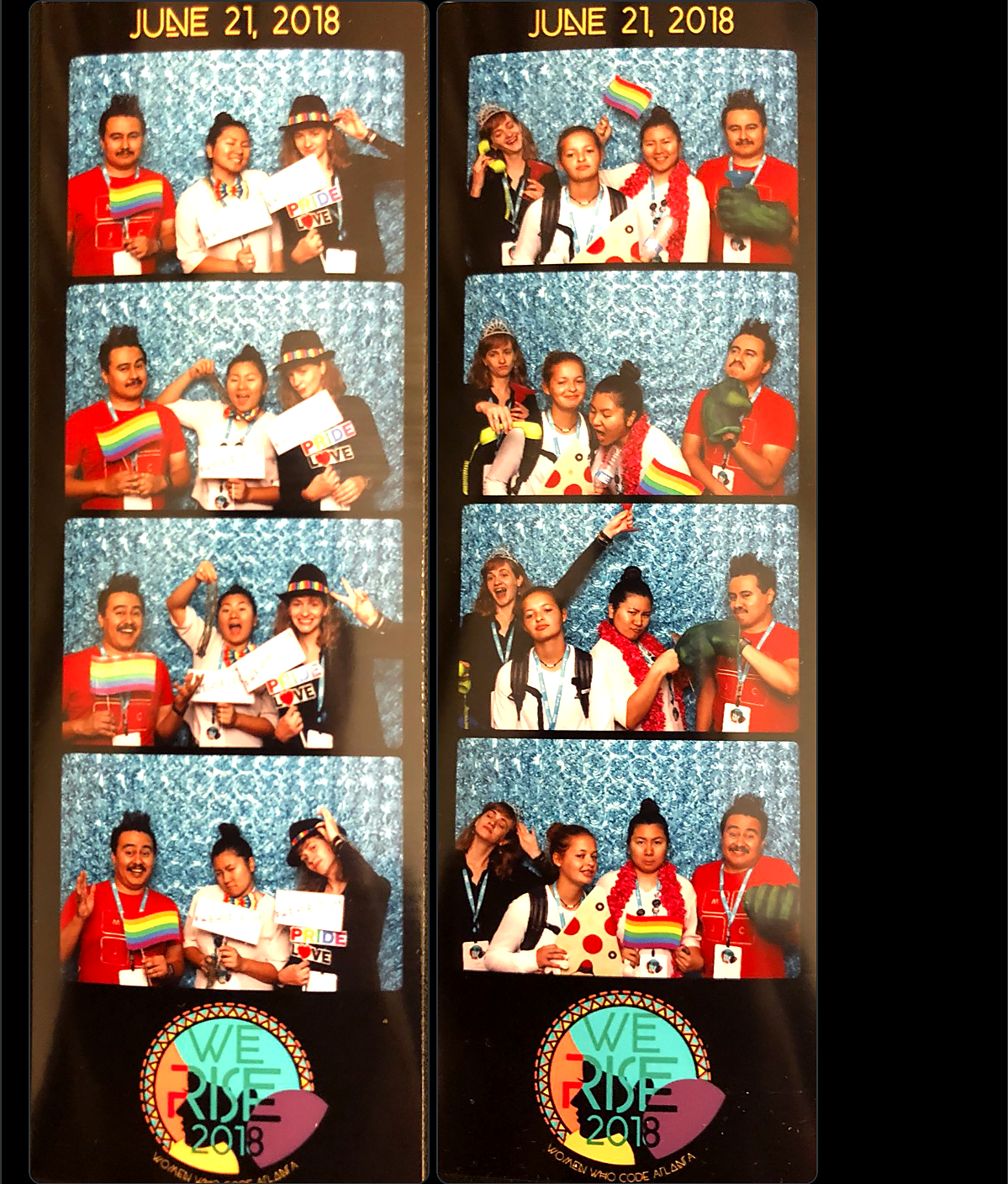
The 2018 conference is where I started running an event identity as a themed expression on a fixed base, the model REFACTR.TECH still uses. The team chose Wakanda. I designed the expression across the tees, the badges, the photo booth print, the speaker cards and the social promotion, and, because the conference fell in June, a co-existing Pride variant on the tee and in the booth props. Two expressions in one edition, applied to different touchpoints for different reasons, without the WeRISE mark itself changing.
Design and revenue sat in the same hands that year. I produced the promotional assets and ran ticket sales, and ticket revenue grew from $30,936 in 2017 to $42,387 in 2018. I am careful about the claim: sponsorship sell-through is a pricing story, told below. Tickets are the part promotion moves, and promotion is the part I designed.
Decisions & tradeoffs
Decision 1: Breadth vs. specialization.
Some chapters focused narrowly on a single technology area. We chose breadth because the audience included women across many career stages and technical paths. The tradeoff was less depth in any single specialty, but significantly broader community reach.
Decision 2: A ticketed flagship that subsidized free recurring programming.
Recurring programming stayed free and sponsor-supported, because charging for monthly meetups and study groups would have excluded many of the women the chapter existed to serve, especially career changers and early-career technologists. The flagship conference was the exception. WeRISE Tech was ticketed and sponsor-funded, generating $81,436 in 2017 and $106,887 in 2018 across tickets and sponsorship. Neither year lost money, and the surplus funded the chapter's free programming for years after the final WeRISE. One paid event a year underwrote everything that stayed free.
Decision 3: Pandemic programming strategy.
When in-person events stopped in 2020, the chapter pivoted fully to virtual programming. This unexpectedly expanded reach through national speakers and broader accessibility. In 2022–2023, the challenge shifted to deciding what should remain virtual and what should return in person. We ultimately adopted a "virtual for breadth, in-person for depth" model.
Decision 4: Leadership succession.
Volunteer-led communities are fragile if knowledge and ownership stay centralized. From early on, we intentionally built a multi-organizer model with distributed program ownership. Decision-making was occasionally slower, but the chapter became far more resilient and sustainable over time.
Outcome
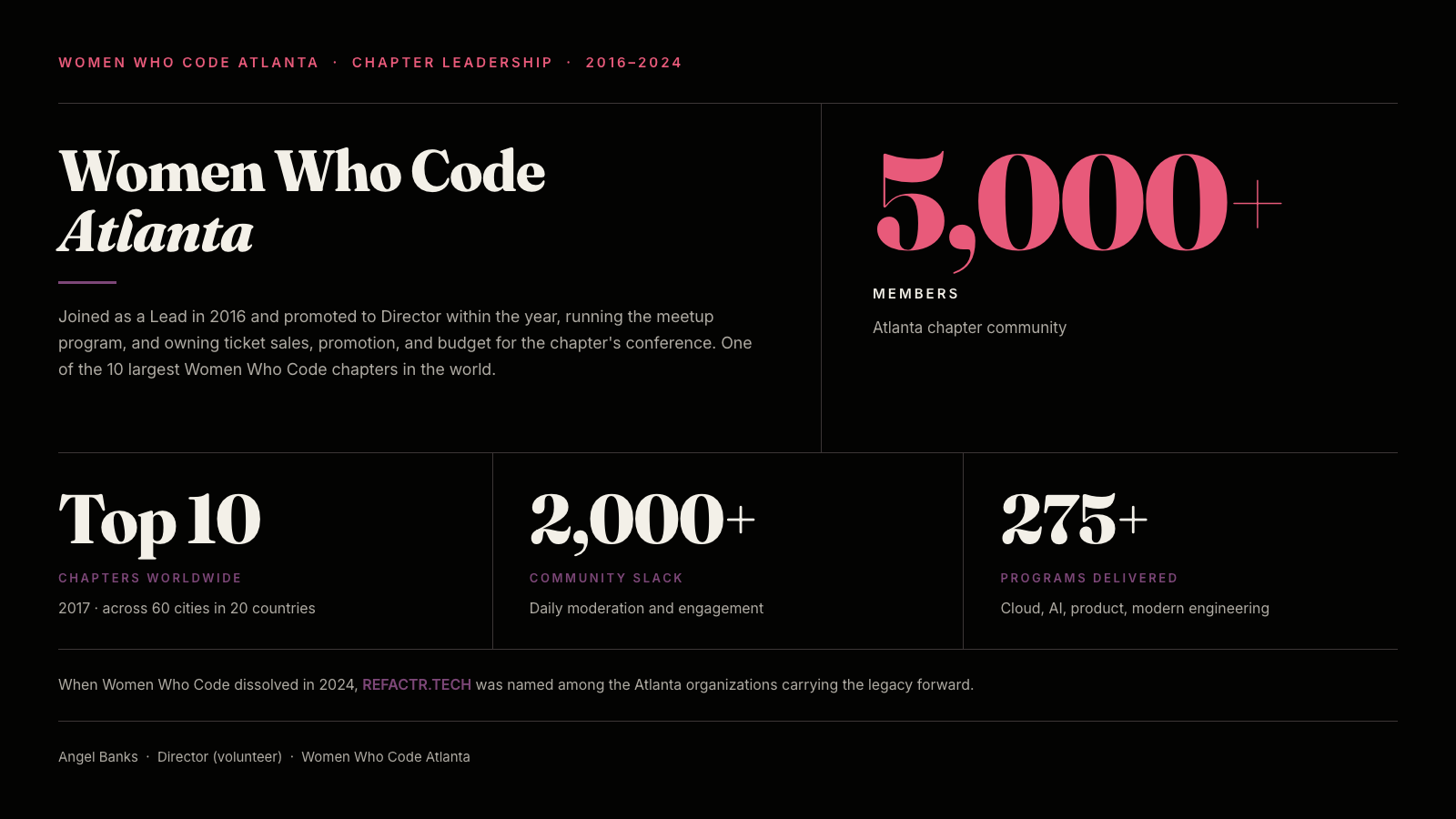
- 5,000+ members, making WWC Atlanta one of the largest WWC chapters globally.
- The chapter ranked top 10 globally among 60 cities in 2017, during my tenure as a Lead.
- 275+ developer education programs delivered.
- $188,000 in combined conference revenue across WeRISE Tech 2017 and 2018, from ticket sales and sponsorship. Neither year lost money.
- 121 speakers programmed across the two conferences, 50 in 2017 and 71 in 2018.
- WeRISE Tech 2017 and 2018 established as flagship chapter events and later informed the creation of REFACTR.TECH.
- A sustainable multi-organizer, partner-funded operating model that continued beyond any one individual.
- A pipeline of organizers and members who advanced into leadership roles, speaking circuits, and senior technical positions across Atlanta's tech ecosystem.
Coverage and press included:
- Women Who Code: Women Who Code Announces We Rise Tech Conference in Atlanta
- Women Who Code: My First Hackathon
- Women Who Code: Tech Diversity Achieves Amazing Results at WWCode Atlanta Hackathon
- Aly in the ATL: Women Who Code coverage
- Hypepotamus: Women Who Code shuts down, but Atlanta members look to carry on legacy. When the global WWC organization dissolved in April 2024, this piece surfaced WWC Atlanta's chapter growth (5,000 members) and the WeRISE Tech conference legacy, naming REFACTR.TECH as one of the local organizations carrying the work forward.
Reflection / What I'd do differently
The biggest lesson from running a chapter for eight years is that community work is product work measured over a longer timeline. The real metric is not whether a single event succeeds, but whether the community remains trusted, healthy, and growing years later.
That perspective changes decision-making. You prioritize long-term operating health over short-term spectacle, invest in organizers more than individual events, and protect cadence and trust above any one program.
Another major lesson was that partnerships compound over time. One-off sponsors are transactions. Long-term partners become part of the operating system.
If I were doing this again, I would:
- Invest in the multi-organizer model earlier.
- Document operational playbooks sooner.
- Build a clearer succession and transition plan from the start.