Senior Program Manager, Microsoft DevRel · December 2025
.NET Day on Agentic Modernization
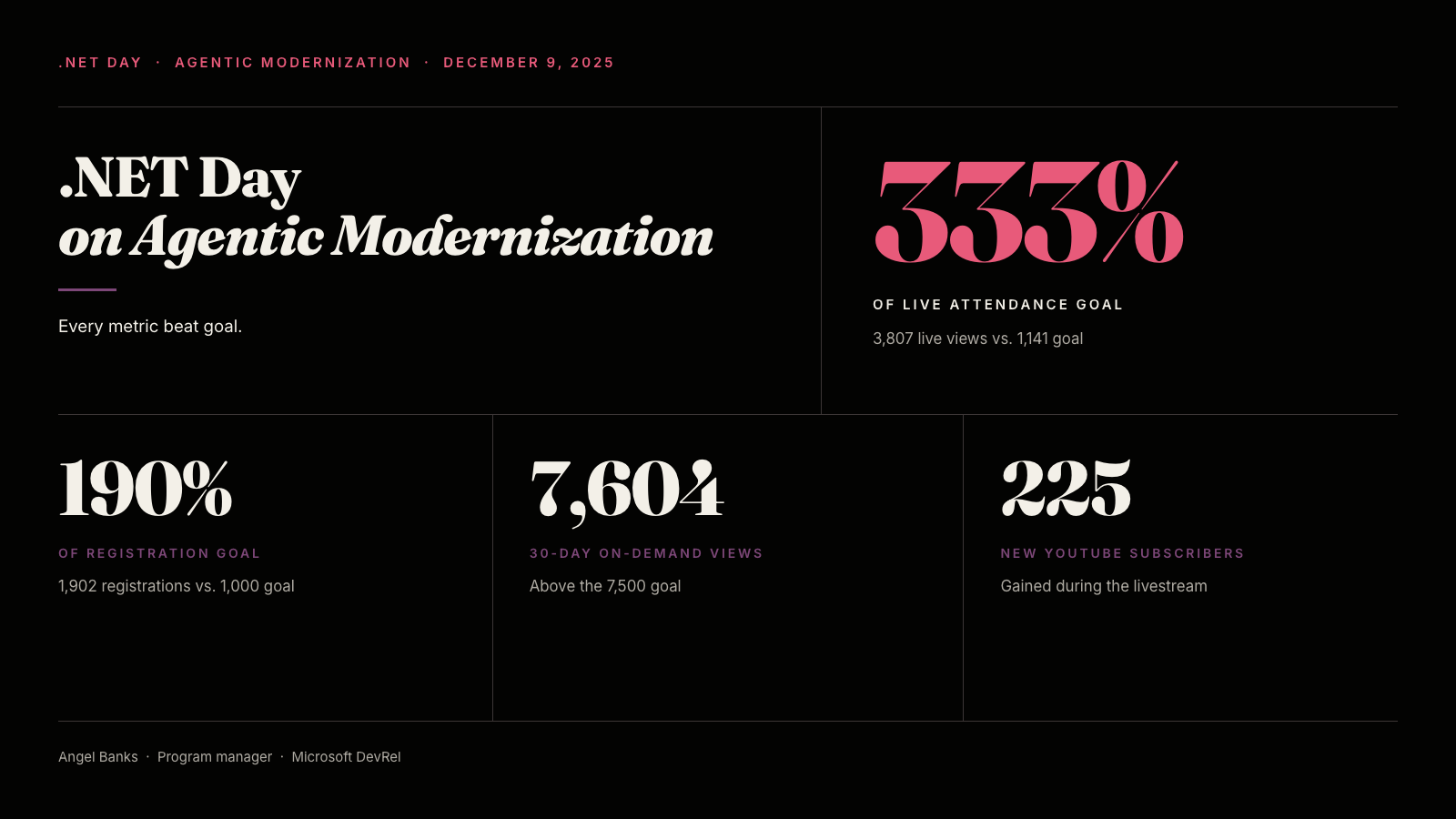
1,902 registrations (190% of goal), 3,807 live views (333% of goal), 7,604 30-day on-demand views, beating every stated goal.
Timeframe: December 2025 (originally scheduled for October 2025; rescheduled around .NET Conf, Microsoft Ignite, and Azure Dev Summit Lisbon).
See it liveWatch the full event on YouTube Event page with agenda
Launch announcements
Context
A meaningful share of enterprise .NET workloads still run on older versions, on-premises, or on infrastructure overdue for modernization, and the modernization conversation in 2025 had moved past lift-and-shift. Customers were asking how to modernize with AI: how to use GitHub Copilot app modernization in Visual Studio to accelerate .NET upgrades and Azure migration, how to boost reliability with Azure SRE Agent, how to build agentic experiences with the Microsoft Agent Framework and Azure AI Foundry, and how to use GitHub Copilot for Azure (via Azure MCP) to automate Azure development tasks.
.NET Conf in November 2025 introduced this story at conference scale. .NET Day on Agentic Modernization was designed to go deeper than .NET Conf could, taking the agentic modernization narrative and programming a single focused day around it for the audience actively trying to move workloads forward.
It existed at this specific moment for two reasons. First, agentic modernization had become a stated FY26 priority for the .NET / Azure Apps GTM motion, and the audience needed a focused learning surface for it. Second, app modernization had been a sustained .NET customer focus, and the deeper, hands-on layer of content the audience was asking for did not fit inside a broad .NET Conf agenda.
Starting state
- High-quality .NET modernization content existed across Microsoft, but was scattered across product docs, blog posts, conference talks, and reference architectures with no curated agentic-modernization sequence.
- The .NET audience that needed this content most — developers and architects on the ground inside enterprise modernization projects — had no single, focused, day-shaped resource sequenced around the agentic modernization story.
- Other .NET DevRel events were either broad (general .NET conferences) or narrow (single-feature deep dives). There was not a focused day event built around the modernization journey itself.
- App modernization was a sustained .NET customer focus. The audience was already asking the questions; what they needed was the day-shaped surface to learn the answers in sequence.
Goals & success metrics
The goals for .NET Day on Agentic Modernization were:
- Curate the agentic modernization story end-to-end into a single coherent day of programming.
- Reach the right audience — .NET developers and architects actively involved in modernization decisions, not casual conference browsers.
- Drive downstream learning by converting event attention into completion of docs, samples, and learning paths that actually move workloads forward.
- Equip the field with a recorded, packaged version of the day that DevRel, Sales, and partners could point customers to in the months that followed.
Stated success targets and results
- Registrations: Goal 1,000 → Actual 1,902 (190%). (Meetup: 239; Dynamics/Reactor: 1,663.)
- Live attendance: Goal 60% of registrants ≈ 1,141 views → Actual 3,807 live views (333%). Peak concurrent viewers: 409. Average view duration: ~16:53.
- 30-day on-demand: Goal 7,500 views → Actual 7,604. Livestream on-demand: 1,944. On-demand session videos (combined): 4,649. Total on-demand watch hours: ~253.
- Engagement signal: 232 live chat messages, 172 likes, 225 new YouTube subscribers gained during the livestream alone.
Scope & constraints
My scope
- Owned program management and execution for .NET Day on Agentic Modernization end-to-end.
- Authored and maintained the core event project doc outlining event goals, themes, audience, scope, and positioning across AI-powered modernization, Azure App Platforms, and agentic tooling.
- Served as event organizer coordinating timing, agenda, and production readiness.
- Partnered with Azure Apps / .NET marketing and PMM to align content with FY26 modernization priorities and GTM motion.
- Led speaker logistics and readiness by sending official prep guidance, deck templates, timing, demo requirements, and studio instructions; collected demo links; ensured sessions aligned to agenda and CTAs.
- Coordinated with DevRel Studios and production partners to ensure live and remote presenters were production-ready.
- Managed day-of live production: monitored YouTube chat to respond to live questions; identified and fixed a broken "Learn more" CTA link in real time by creating and validating a corrected
aka.mslink while the stream was live. - Supported GTM alignment with marketing on registration, reminder, and follow-up communications; ensured agenda, CTAs, and on-demand links were accurate and consistent across email, social, and YouTube descriptions.
- Coordinated cross-functionally with the .NET CA lead, DevRel Studios production, Azure Apps Marketing, and product teams across .NET, Azure App Service, Azure AI, Azure SRE Agent, GitHub Copilot, and Microsoft Agent Framework.
Constraints
- Virtual event economics: the audience can leave at any moment, so programming has to earn attention session by session.
- Qualified reach over raw funnel: a focused-audience event means a smaller registration number than a broad conference by design. Success had to be measured by the right audience showing up, not top-of-funnel volume.
- A crowded November/December event calendar. The event was originally scheduled for October, but we pushed it to December for two reasons: (1) most relevant product announcements were planned for .NET Conf in November, so an October date would have been ahead of the news, and (2) several potential speakers were committed to Azure Dev Summit 2025 in Lisbon. Even getting pre-recorded sessions was difficult because speakers had conflicts and overbookings across .NET Conf, Microsoft Ignite, and other internal events landing in the same window.
Approach
I treated the day as a curated narrative arc, not a stack of independent talks.
- Programming arc: Sessions sequenced from "where agentic modernization starts" through "what good looks like at the end," so a developer or architect could follow the day as a single learning journey.
- Speaker curation: Speakers selected for technical depth on the specific agentic-modernization moment they were teaching, with explicit attention to a representative lineup.
- Paired learning content: Every session paired with docs, samples, or learning paths attendees could run themselves the next day, so attention converted into action.
- Field readiness: Recorded sessions, decks, and paired resources packaged after the event so DevRel, Sales, and partners had a reusable artifact for customers in the months following.
- No keynote by design: .NET Conf had just happened in November, and any keynote would have overlapped heavily with the already-recorded .NET Conf keynote. The purpose of this day was to go deeper than .NET Conf, and skipping the keynote freed time for the deep technical sessions the audience actually came for.
Decisions & tradeoffs
Decision 1: Focused day-event vs. multi-event series.
A multi-event series would have spread the content across weeks, given each session more breathing room, and added more top-of-funnel touchpoints. A focused day created a single, high-attention moment where a developer or architect could clear their calendar and consume the full agentic-modernization story in sequence.
We chose the focused day because the audience we cared about — practitioners actively modernizing workloads — benefited more from a coherent end-to-end story than from scattered weekly sessions they would dip in and out of.
Decision 2: Curated speaker lineup vs. open CFP.
We ran a curated lineup selected by speaker and topic together, chosen for the specific agentic-modernization moment each session needed to teach. The tradeoff was less surface area for new voices than a CFP would create, but the upside was tighter narrative control across the day and higher confidence in technical depth.
For a "go deeper than the conference" event, narrative control mattered more than discovery breadth.
Decision 3: Live-first production with on-demand as the long tail.
We produced live in DevRel Studios in Redmond for speakers who could make it on campus, then edited the broadcast into individual session videos for on-demand.
The live event was the broadcast moment; on-demand was the long tail and the reusable field artifact. The numbers validated the call: 3,807 live views (333% of goal) plus 6,593 on-demand views to date show the model worked at both ends.
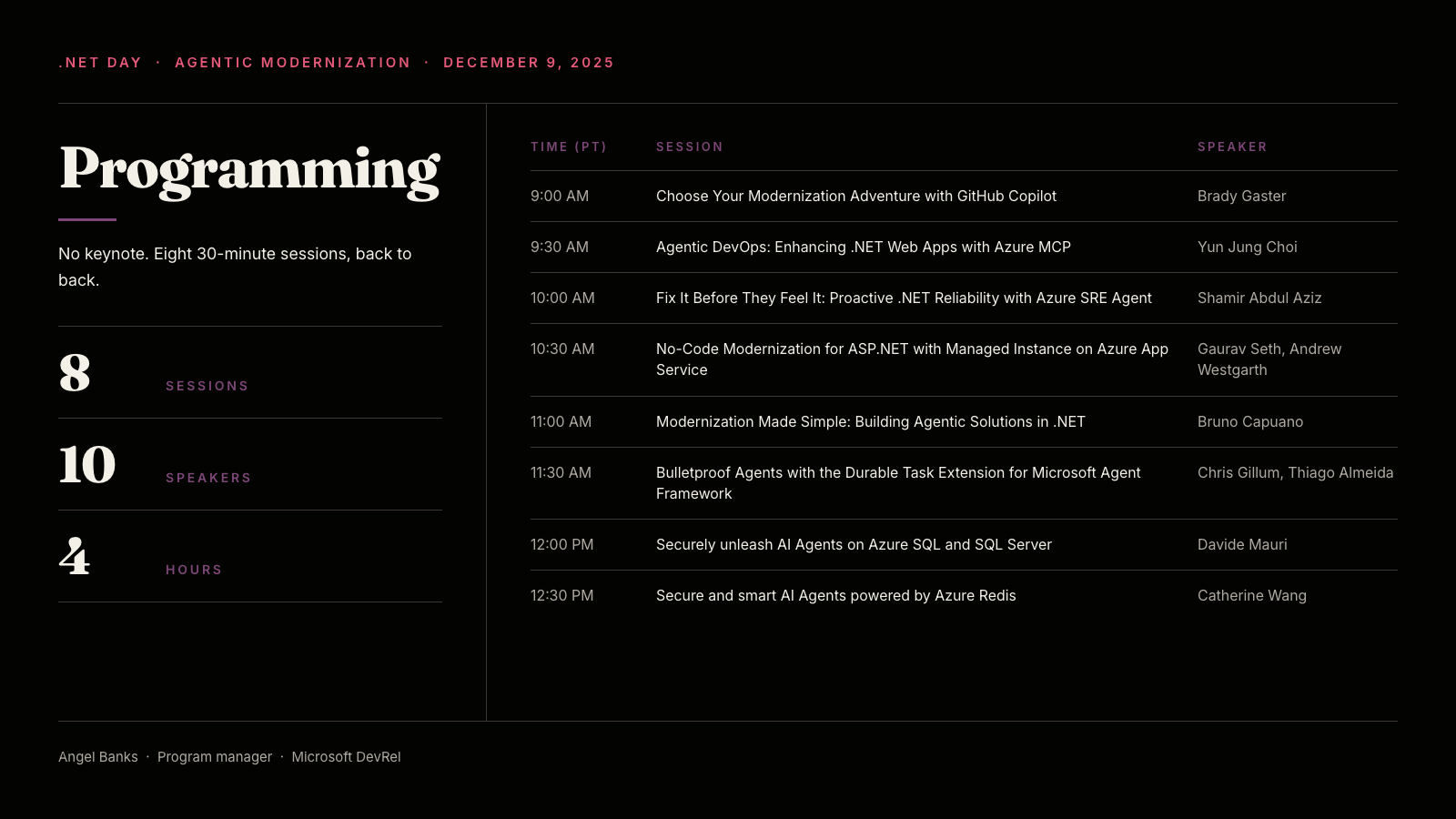
Decision 4: No keynote, plus a 4-hour day shaped as eight 30-minute sessions.
Two related calls: skip the keynote and cap the day at four hours of programming structured as eight 30-minute sessions.
The four-hour cap came from past live-event data — beyond four hours, virtual attendance falls off sharply. Eight 30-minute sessions gave us depth per topic without overrunning the audience's attention budget.
The tradeoff was less time per topic than a 60-minute format, but the discipline forced sharper sessions and held audience attention throughout the day. Average view duration of ~16:53 — more than half a session — suggests attendees stayed inside sessions rather than dipping in and out.
Outcome
Registration & attendance
- 1,902 total registrations — 190% of the 1,000 goal. (Meetup: 239. Dynamics/Reactor: 1,663.)
- 3,807 live views — 333% of the live-attendance goal of 1,141.
- Peak concurrent viewers: 409.
- Average view duration: ~16:53 — more than half a 30-minute session, indicating attendees were watching sessions through rather than skimming.
- 232 live chat messages, 172 likes, and 225 new YouTube subscribers gained during the livestream alone.
On-demand performance
- Livestream on-demand: 1,944 views.
- On-demand session videos (combined): 4,649 views.
- Total on-demand views to date: 6,593.
- Total on-demand watch hours: ~253 hours.
- 30-day on-demand: 7,604 views — above the 7,500 goal.
Operational outcome
- A packaged, field-reusable artifact consisting of recorded sessions, decks, and paired learning resources that DevRel, Sales, and partners could share with customers in the months following.
- A proven event format — focused day, no keynote, eight 30-minute sessions, and live-in-studio production with an edited on-demand long tail — that beat goals across registrations, live attendance, and on-demand reach simultaneously.
Reflection / What I'd do differently
.NET Day on Agentic Modernization reinforced that a curated, sequenced narrative-arc day reaches a different audience and produces a different outcome than a stack-of-talks event, even when the speakers and content are similar in raw quality.
Audiences working inside long, difficult, multi-quarter projects like enterprise .NET modernization reward programming that respects the seriousness of the work. They show up when they trust the day will be worth their time. The 333% live-attendance number is not just a marketing number; it is a trust signal.
The schedule also reinforced that the right date is the one that makes the content land, not the one originally on the calendar. We pushed from October to December for two practical reasons: letting .NET Conf happen first so we could go deeper on its content, and working around speaker conflicts at Azure Dev Summit and other November events.
The pushed date was the right call. Holding the original date would have meant a thinner lineup and less substance to build from. Flexibility on the calendar protected the quality of the event.
If I were doing this again, I would:
- Invest earlier in paired learning content. Every session should ship with docs, samples, and learning paths attached from day one, not retrofitted afterward. The conversion from "I watched a talk" to "I ran the sample" is where the actual modernization journey begins.
- Treat the day's recording as the primary artifact, not a byproduct. Designing for rewatch and field reuse from the start changes how you produce, package, and promote the content afterward. The 6,593 on-demand views to date show the long-tail value should be designed in from the beginning.
- Lock the speaker calendar earlier and treat the November/December conference cluster (.NET Conf, Microsoft Ignite, Azure Dev Summit) as a known planning constraint rather than something to react to midstream.